Back
UPowr's help centre
UPowr's help centre was a simple text site that customers couldn't reach from inside the product. Whenever they had a product question, they'd default to email, which was slow for them and unsustainable for us.
Making the case. I'd been pushing for embedding the help centre inside our product. As the customer support load grew, the case became hard to ignore.
We chose Help Scout because it made linking to documentation easy. Its Beacon widget brought the help centre, AI answers based on its content, and a contact channel to the team into our product. I rebuilt the help centre from scratch.
The work had three main parts.
Information architecture. I designed an eight-category structure. A Getting started path for new customers, two categories for the work they do, sales and service, four for the tools, and one for product updates.
Articles. I wrote every article in plain language, varying the structure depending on whether it explained a concept, walked through a task, or served as a reference.
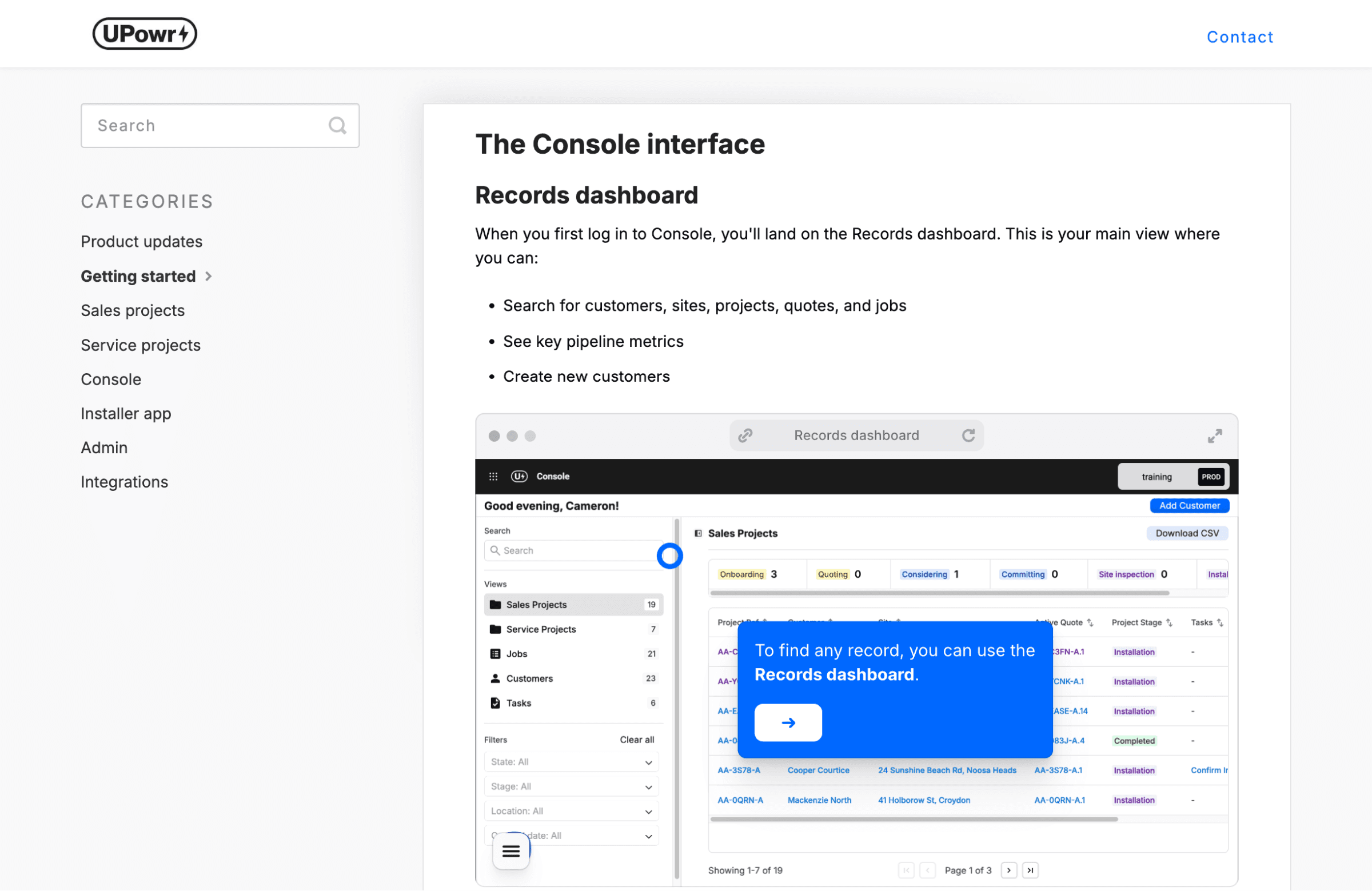
Interactive walkthroughs. For key task articles, I recorded interactive walkthroughs and embedded it inline so customers could read or click through it.
Keeping it current. I ran the release cycle after launch, updating articles for every product release and pushing in-product announcements through the Beacon. To do that properly, I used the Help Scout API to export the full set of articles. When a feature shipped, I could check what I was writing against everything already there, and find every page the change touched.
What worked. The interactive walkthroughs were the part customers responded to most. One specifically called them out in onboarding feedback.
"I liked having the guide side-by-side while performing actions."
An interactive walkthrough built in Arcade
Shutting it down. The mid-market customers it was built for hadn't arrived, and the enterprise partners we did have preferred to email us, so I made the call to close it.
My takeaway. Customers don't ask for help from a separate site. They ask from where they are. Embedding mattered, and so did letting them ask in their own words rather than search for the right article.