Back
Wage Subsidies at BIT
Unemployment can be devastating. It causes psychological harm, and it affects a person's family and the wider community. To tackle this, the Australian Department of Jobs and Small Business created wage subsidies, an incentive of up to $10,000 to encourage businesses to take on job seekers who are Indigenous, long-term unemployed, older, or younger. But despite the benefits, take-up was extremely low. They hired the Behavioural Insights Team, a social-purpose consultancy, to find out why.
Research. To begin, we wanted an idea of how the subsidies were being used. They're administered by job service providers, specialised recruitment agencies contracted by the Australian Government, so we started with an anonymous survey and group interviews with over 150 staff across multiple providers. Three things came out of it.
Many employers were put off by the name. "What's wrong with this person?" was a common remark, and terminology like "long-term unemployed" didn't help.
The first payment to employers came after 14 weeks, and many contracts were terminated before that point.
Over two-thirds of staff found managing the subsidies difficult.
Digging deeper. We then worked closely with one provider, listening in on phone conversations between their staff and potential employers, and mapping their admin process with them. I designed the survey and the process map.

The process map and interview themes
Co-design. Working with the same provider, we ran a workshop with their staff in which we outlined our research findings and basic behavioural science principles and co-designed solutions. Taking these away, refining them, and incorporating insights from the behavioural science literature, we came up with four fixes. We took those back to a second workshop, revised them again, and shipped what the provider signed off.
We removed negative terminology and renamed it from "Wage Subsidies" to "Employment Bonus".
We simplified admin, so employers could sign contracts online.
We front-loaded payments, so employers started benefiting from the subsidy much sooner.
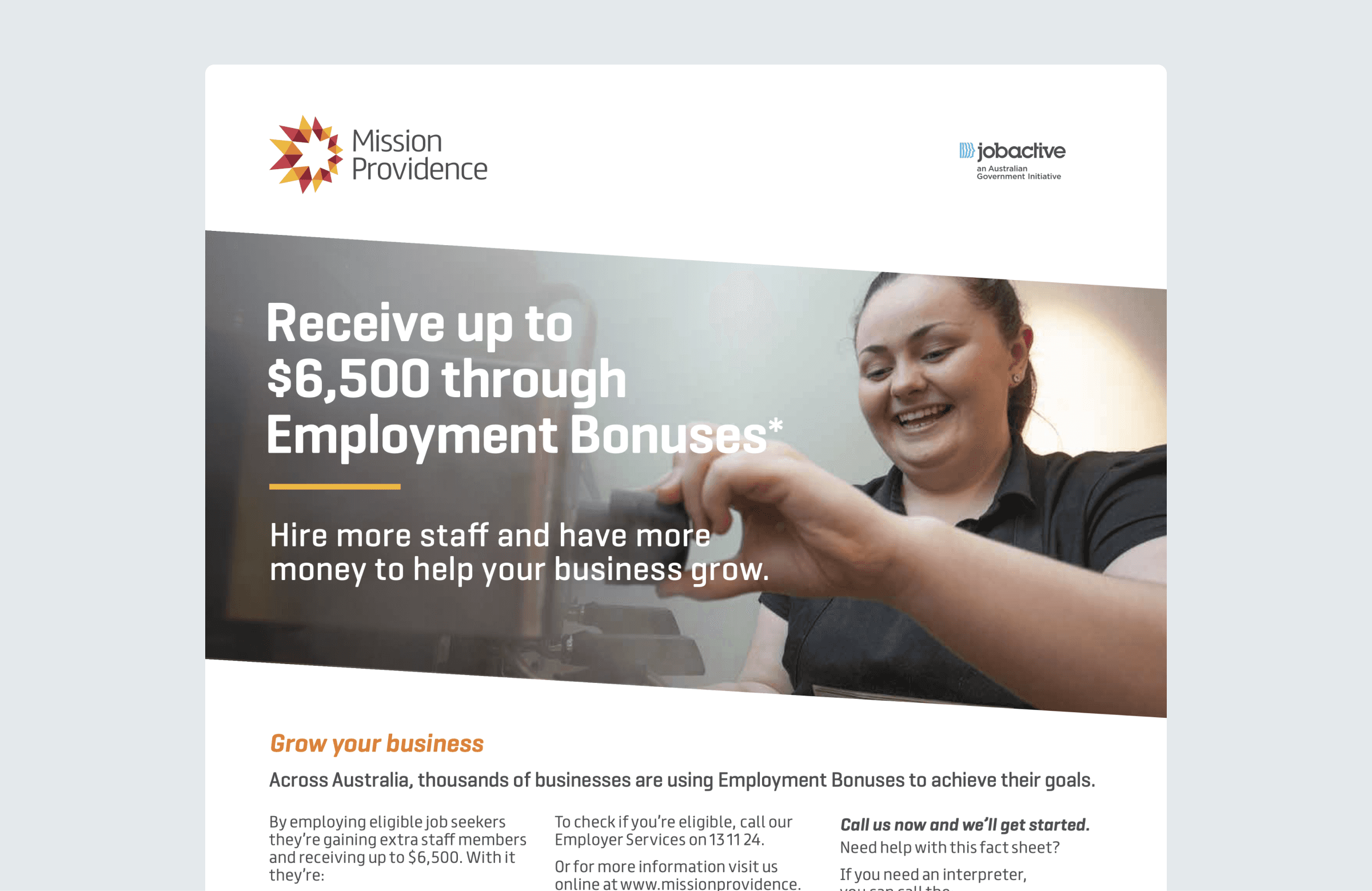
We gave staff resources to help them promote the subsidy, including scripts, templates, training guides, and flyers that I created, in four versions so staff could grab the one that fit.
The trial. Five teams across seven offices in South West Sydney, 1,436 employers. We used a cluster randomised controlled trial with a stepped-wedge design, in which teams crossed over to the new process in a random order drawn from a container on video.
What happened. Promotion of wage subsidies increased by 60%, from 3.5 activities per day to 5.6. The average time taken to sign a contract dropped from 17 to 11 days. Two more contracts were signed at each site per month, which is two more people finding work.
Influencing policy. The contract signing process was permanently moved online, some of the worst-offending terminology was changed, and an upfront 40% kickstart payment to employers was introduced in 2017.
What didn't work. At four weeks, job seekers placed under the new process were less likely to still be in work, at 69% compared with 79%. Smaller drops at 12 and 26 weeks. None of it was significant, but it isn't the direction we wanted.